🐝🐝🐝 Bloof will be closed Monday 10/19–Thursday 10/22. Orders placed during those days will ship Friday 10/23. 🐝🐝🐝
The Social Distancing virtual bookstore sale continues: 30% off all our current books and chapbooks! (Preorders for forthcoming books will be discounted separately.) BE WELL. READ POETRY.
Handprinted linocut cover
Gold metallic Cranfield Traditional Relief Ink on cream 80 lb cover
Digitally printed interior on cream opaque 70 lb text
Hand sewn in natural twine
Note: Individually printed by hand in small batches, no two covers will be exactly alike. Expect minor variations across the edition. Thank you, readers, for your incredible support of Bloof’s handmade series. Full series subscriptions are sold out, but you can create your own custom bundle (discounted shipping) with the books that remain!
The eighteen poems in Rat Queen luxuriantly explore transgression and intimacy, the various ways we take each other eagerly apart and taxidermy ourselves back together again. “My dear, what muscularly defines you?” the speaker asks, “When I pin you like insect wings, / corked-fog and iridescent-under.”
Rat Queen is the fourth chapbook in the 2019–2020 series from Bloof Books. Each chapbook in the series is released in a limited edition of at least one hundred numbered copies, followed by a digital release, and eventually in a combination volume called Bound.
This is Katie Jean Shinkle’s fifth chapbook. She is an Assistant Professor in the MFA Program for Creative Writing, Editing, and Publishing at Sam Houston State University. She is the author of three full-length works, most recently Ruination (Spuyten Duyvil, 2018). Her poetry, prose, and criticisms can be found in Flaunt Magazine, the Georgia Review, Denver Quarterly, New South, the Collagist, Washington Square Review, and elsewhere. She serves as associate fiction editor of ANMLY, co-poetry editor of DIAGRAM.
ExcerptRAT QUEEN
Let me cry 1,000,000 tears of gold,
weave tapestry strands with vigor,
douse your open heart with champagne,
only the best, most expensive will do.
Show me Benjamin Franklin,
fanned out to cool, I will show people
you forget along the way. Tell me,
while at my feet, how the bank
of booze is vampiric and fanged.
The equation of who will perish first,
(w)hol(l)y simplistic: You, knee-crouched,
or me, hands in prayer, eyes transfixed?
So funny what we cling to,
not giggles or open-mouth hardy,
but uncanny, filled to the brim.
FIRST THE BURNING by Catie Rosemurgy has sold out. If you recently placed an order (or are in the class in Tuscaloosa), never fear. We are printing an additional small run to fill all current orders. THANK YOU.
The first printing of the new hardcover edition of Nikki Wallschlaeger‘s I Hate Telling You How I Really Feel has arrived at Bloof HQ in vivid full-color. The preorder special (a couple bucks off) is still available, because we’re sweet like that.
We’ve asked our authors to submit highlights from their reading this year— anything outstanding they read during the year and want to share, whether published this year or not. As a countermeasure/contrast to the typical year-end Best Of lists compiled by various mainstream media outlets (which are often linked to ad buys, or shared parent companies, o did you not know that!?), expect these personal lists to point in less expected directions. We’ll be posting our poets’ picks as they come in over the next week or two. Enjoy. —Bloof
Photo by Hassen Saker
Brink
Shanna Compton is the author of Creature Sounds Fade (Black Lawrence, forthcoming in 2020), Brink (Bloof, 2013), For Girls & Other Poems (Bloof, 2008), Down Spooky (Open Book Award Winner, Winnow, 2005), and several chapbooks. She’s currently working on The Hazard Cycle, a book-length speculative poem. Her poetry and essays are widely published, appearing in Best American Poetry, the Nation, American Poetry Review, McSweeney’s, the Academy of American Poets Poem-a-Day series, and elsewhere. She works as a freelance book designer and editor in Lambertville, NJ.
Because I work as an editor (here & for independent authors) and book designer (here & for other small presses), a great deal of the reading I do each year is pre-publication. In other words, I’m reading the future. As a result, I’m also often reading the past, catching up on things from previous years I didn’t have a chance to read right when they were first released. And like all of us, as a writer I’m often organizing my reading around/toward whatever project I’m personally working on. Here are some things I read this year from each of those categories.
This is an excellent example of my future-reading dilemma. I’ve been reading & learning about Chinese poetry’s history and various movements from this anthology edited by Ming Di (which I designed for Black Square) since I first got the manuscript in 2017. But it’s not yet available for preorders. Just trust me: write it down now as something to look forward to and teach from, and a month or so into 2019 check the website again here.
I have dreamed of this book existing for many years. Farnoosh Fathi’s tremendous work restores one of our lost poets to us. Hooray.
The hour like a child runs down the angle of star and rests at the bottom It is a staring woman that may hold that child in its arms But women prefer to see the hours slip from their fingers For that are dancing an old earth constituency
I am a little beyond the river and stare from my particular casement I am slender as the stalk and have my own flowering I don’t draw from women but I prefer the truth and not the trick of living
I must forgive myself for waiting so long. I know a woman who waits is offensive but I just can’t get over my flaws
& now they might zero me out. My blood is a zone of dispute, a tropic of fault. Since I’ve waited so long, I must forgive myself.
The Taiga Syndrome Cristina Rivera Garza, translated by Suzanne Jill Levine & Aviva Kana (Dorothy Project)
I’ve never met a Dorothy Project book I haven’t loved. This is book is both thoroughly odd & unexpectedly gripping. It shouldn’t work, but it does. A sort of speculative detective verse-prose novella.
I remember the light through the many windows. Memory dangles these windows in front of me, at daybreak, just barely covered by a thin linen curtain. Then the same windows in the middle of the day, opened wide. The windows again in the evening, and above all, I remember the hands on them, all over the glass. And the nostalgia of this, of what’s on the other side the great beyond, as it used to be called. Above all, I remember I used to exhale in front of them, in front of the glass, and write with the tip of my index finger the words “I am leaving here” and “I will never return.”
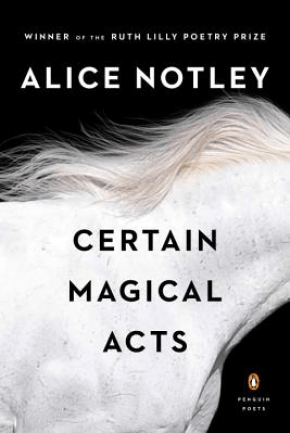
I’ve been rereading Alice Notley—because of the book I’m working on, she’s a poet on perpetual repeat (not that we sound alike, but she sustains and bristles weird energies over a long-form poem like no one else). So I could have chosen The Descent of Alette again, or Benediction, or Alma, but I’m going with this one because I finally got to see her read this year, last month in Princeton. She read the first poem from this book, “I Couldn’t Sleep in My Dream,” then several from a newer unpublished series she’s been working on to recover some lost memories (so lots of anecdotes & recognizable poet figures), and a few other things. She talked a bit about her process for her book-length work—having an idea, finding a form to contain it, and how she “doesn’t write collections. Well, this [holds up this book] is a collection.”
The sun is rising, and light enters my old house. What sun is this? The desert star or some one flame as in transcendence? I won’t as it. I won’t ask anyone anything. I got tired of being childish. In your assigned role you were a woman. But I’ve always been a poet, that’s all, no sex or race, no age or face. Can Eternity strip me of it? That’s only another word. I’m inside myself, and inside it. Today’s the new fact. Are there others there?
…I have to dig deep below the fold to find stories about how he turned his back on boys who were quilting America’s cities in gay enclaves. Many Black women died of the same neglect and, Good Lord, I remember the news used to talk about babies, blood saturated in suffering. Not today, though. Today, the papers can’t even speak of his war without casting that failure, also, as a bid for peace. So, please, when I die, forget all the fires I set.
When the culture passed over We bathed in its light in its fear in its Mountain stream. We left mountains Of carts full of junk behind. We bade them Farewell. They bade us Weep and know shape They bade us be hard. Without power, I wielded my body
Disclaimer: I’m in this too, but it’s still brilliant. Including terms such as viral avatar (Danielle Pafunda), ecobereavement (Bhanu Kapil), negative corpuscuity (Vishnu Aggarwal), cloudygenous (Eileen Tabios), this unique work of speculative nature writing/ecopoetics opens several new portals.
This ingenious & gorgeous fold-out chapbook is alas sold out. But look at it! I hope the photo is good enough here for you to read, but you can also find some of the poems on Candace’s website.
I didn’t mean to assemble my whole career on lies, so now I blast holes in the men. I blast holes in the prints of the men. I blast holes in the holes who are the men. I move them in a process called autonomous fetishization, and they enjoy the hazards of my queenly thinking. I grip their cheeks
mercy learn in a permanent lockdown you should work in a permanent lockdown you could play fuck walk in a permanent lockdown birth sleep eat in a permanent lockdown wake tweet fight swim shift thou pluckest me out in a permanent lockdown
“Aging” Rosmarie Waldrop (Academy of American Poets / Poem-a-Day)
I don’t know Rosmarie Waldrop personally, but she’s an important model for me as a poet/publisher so I always feel very close to her work. I love this poem.
The road toward rotting has been so long. We forget where we are going. Like a child, I look amazed at a thistle. Or drink cheap wine and hug my knees. To shorten the shadow? To ward off letting go?
Beast Meridian Vanessa Angélica Villarreal (Noemi Press)
Visually, aurally, and typographically complex—including photographs, text collages, mixed languages. Both mournful and hopeful, this wide-format book is a luxuriant physical experience. I don’t think representing it with a snippet online is enough. Sit with it in your lap.
Kate’s work often mixes elements of visual art, samples of her handwriting, photographs, and multiple shifting viewpoints that create kaleidoscopic patterns. There’s nothing quite like living for a while inside one of her books.
15. Introvert
Deep in my own green element, I met a friend. My double, my dearest.
Others pulled me out of the sea, placed me
in this pan of water, added salt and taught me to eat bread.
We’ve asked our authors to submit highlights from their reading this year— anything outstanding they read during the year and want to share, whether published this year or not. As a countermeasure/contrast to the typical year-end Best Of lists compiled by various mainstream media outlets (which are often linked to ad buys, or shared parent companies, o did you not know that!?), expect these personal lists to point in less expected directions. We’ll be posting our poets’ picks as they come in over the next week or two. Enjoy. —Bloof
Elizabeth Clark Wessel
Excerpt from Seeking an Older, Well-Educated Gentleman by Kristina Lugn, translated by Elizabeth Clark Wessel
Elizabeth Clark Wessel is the author of four chapbooks of poetry, a founding editor at Argos Book, and the translator of numerous novels from the Swedish, including most recently What We Owe by Golnaz Hashemzadeh Bonde. Originally from rural Nebraska, she spent many years living in New York and Connecticut, and these days calls Stockholm, Sweden home.
She has translated a chapbook of poems called Seeking an Older, Well-Educated Gentleman by Kristina Lugn that is forthcoming from Bloof in 2019, in the handmade chapbook series.
Here in no particular order are some of my favorite chapbooks of the year. A few are by friends and some share a publisher with me, but my admiration is absolutely sincere. I can’t say my reading has been expansive enough to make any claims to a “best of” list, but I do feel sure that more readers should and would enjoy these beautiful & various projects.
Also, Argos Books, which I coedit, published two chapbooks, a full-length, & a calendar this year. I want everyone to read them because I love them so much. You can check it all out here.
We’ve asked our authors to submit highlights from their reading this year— anything outstanding they read during the year and want to share, whether published this year or not. As a countermeasure/contrast to the typical year-end Best Of lists compiled by various mainstream media outlets (which are often linked to ad buys, or shared parent companies, o did you not know that!?), expect these personal lists to point in less expected directions. We’ll be posting our poets’ picks as they come in over the next week or two. Enjoy. —Bloof
Catie Rosemurgy
First the Burning
Catie Rosemurgy is the author of two books of poems, My Favorite Apocalypse and The Stranger Manual, both from Graywolf Press. She is the recipient of fellowships from the Pew Foundation, the National Endowment for the Arts, and the Rona Jaffe Foundation. She lives in Philadelphia and teaches at the College of New Jersey. First the Burning is an excerpt from a longer book in progress, The Forthcoming Disasters of Gold River.
Bloof published First the Burning in our handmade chapbook series earlier this year (and there are only a handful of copies left).
This poem has been my 2018 anthem, incantation, spell, mantra:
Opening of “Prospekt” from Some Beheadings by Aditi Machado
Every day I wake & my life
is private. I see a sun. A coiling
memoir. There is anaphora
in the sun. There is a sun,
it has brightened. A loss in this
unyielding every day I wake—

there is privacy. A mirror
brightens the fascist
in me. When the speech
is made the proscenium
erects everyday
theater. I make a kind
of debris. When I speak
the fascist in me speaks:

O countries & natives, o
wordless obeisance, o privacy
coiling in the memoir—

a great book I will write
is not my private life. A tornado
is simply warning for nothing
that appears out of chaos. A sun

in the fascist, in the hard cold
private life of the citizen, I
make a breakfast. There is a sun
still. There is a house
I move through. A bracken,
a tongue meet.

A bracken, a tongue.
A bracken, a tongue.
A tongue, a tomb
I move through
to arrive at word-like
edifice. Gingerroot,
canna, asparagus, iris.
There is a room
I cook in. There is a
sun outside of it.
I empty a vase,
I fill a bowl,
floral notes, spice.
The throat is a corset
I wear, I tighten,
from which I exude.
I eat, I speak,
it is sexual. Prep
work, like eros, is
in the minutiae.
We’ve asked our authors to submit highlights from their reading this year— anything outstanding they read during the year and want to share, whether published this year or not. As a countermeasure/contrast to the typical year-end Best Of lists compiled by various mainstream media outlets (which are often linked to ad buys, or shared parent companies, o did you not know that!?), expect these personal lists to point in less expected directions. We’ll be posting our poets’ picks as they come in over the next week or two. Enjoy. —Bloof
CAConrad
The City Real & Imagined
CAConrad is the author of nine books of poetry and essays, the latest is titled While Standing in Line for Death (Wave Books, 2017). A recipient of a Pew Fellowship in the Arts for Literature, they also received the Believer Magazine Book Award and the Gil Ott Book Award. CA is currently working on a (Soma)tic poetry ritual titled, “Resurrect Extinct Vibration,” which investigates effects the vibrational absence of recently extinct species has on the body of the poet and the poems. They teach regularly at the Sandberg Art Institute in Amsterdam, and their books, essays, films, interviews, rituals and other publications can be found online at their website.
Poetry is how I spend my life, reading and writing it. We are living in the most abundant and sumptuous time for publishing poetry and I can no longer entertain people who whine to me that they would rather be living in times of poetry’s past. Each year I enjoy focusing on one book at a time while also reading favorite poems and passages of previously loved books. This year I relished 18 closely lived-with books, and they are the soundtrack of my 2018. I remember which book I was reading on the solstices, equinoxes, New and Full Moons, and the times with my truck driver boyfriend Tre reading out loud together late into the night while gazing out his truck window at the dome of stars over Florida, Alabama, New Mexico, Arizona, Colorado, Iowa, Nebraska, Montana, and Idaho. Love and Poetry is the same banquet! Something utterly sacred about these banquets! Thank you, Shanna Compton, for asking Bloof authors for reading lists! These are the 18 books that made my 2018 amazing, and quite grateful to be alive:
We’ve asked our authors to submit highlights from their reading this year— anything outstanding they read during the year and want to share, whether published this year or not. As a countermeasure/contrast to the typical year-end Best Of lists compiled by various mainstream media outlets (which are often linked to ad buys, or shared parent companies, o did you not know that!?), expect these personal lists to point in less expected directions. We’ll be posting our poets’ picks as they come in over the next week or two. Enjoy. —Bloof
Hailey Higdon
Packing
Hailey Higdon writes poems, letters, essays, stories, novels, children’s books, and not-too-bad greeting cards. She creates sound poem experiences about once a decade. Hailey is the author of several poetry chapbooks including: A Wild Permanence (Dancing Girl Press),Rural (Drop Leaf Press), The State In Which (above/ground), Packing (Bloof Books), and How to Grow Almost Everything (Agnes Fox). Her first full-length collection, Hard Some, is available from Spuyten Duyvil Press. She is originally from Nashville, but currently lives and works in Seattle. Website: www.haileyhaileyhailey.com
Living room / Arthur Smith, Architectural Digest, October 1983.
I want you to come now! I want you to come now at the latest! Bring your pocket calculator. And the grand piano. Bring band-aids aspirin eau de cologne and antiseptic soap a bottle of seltzer a bottle of gin a bottle of whisky and toothbrush mug a bottle of Ajax and a large pack of sleeping pills a houseplant a pizza and a respirator. I want you to come now! Only you should come now at the very latest! And take me by storm. Turn out the lights. And light the candelabras. You should unplug the telephone jack. And blow up the air mattresses. You should dry my tears and talk some sense to me. When the sun goes down behind the Opera House. And it’s time to go home. Then you should come to me. With your heart. And your shotgun. So I’ll never lose my temper again. In a tastefully furnished living room. So I’ll never stand on the window ledge again. Looking a little stupid. With a dog rose in my hand. So I’ll never creep through the subways again with an embarrassing song. On my broken lips. You have to come now, now at the very latest! Simply because I can’t stand it otherwise. Simply because it’s so damn persistent. Simply because I’m a totally ordinary woman. Completely healthy and moderately overweight. Somewhat domestic, helpful and nervous. Kind and sweet and very scared. With general interests and an untapped literary vein.
“Am I then this one fact forever,” he said… “Until time runs out,” she said, pushing Her golden bangs away from her eyes. Oh,
And the maples were Already splotched with burning.
Snow filled the muddy footprint. You could tell they were in for it.
Sore appendages. Raw throats. Why did we keep returning To bear witness to the same truth: something In here is living with us.
We ate again. Sausages, wild rice— A salad of lettuces.
A new average settled in. The unspoiled time Of the future lay inside a forked past.
“The mice are well-fed at least,” she blurted out. It was evening. The moonlight did something to her. To him. Oily crumbs of stars on the newsprint sky. We all laughed. We had another one.
There will always be a gun at your back. Or
                                                                                         your front. Or
somewhere near where your fear
churns.

And it is not your job to defer the end. Or the bleeding.
It is your job to keep the heart
pumping.
Its violent living and scarlet song. Some would even
say that
maybe the gun is a
device.
That perhaps, it is actually
Love.
Because love can stop the heart's
heaving or push it to a sure                    sprint. And
maybe you can stop Love, but it is not your job to. Maybe the gun
is a metaphor for Loving and being Loved and fearing the person
who has a gun to your back. That they will
one day use it to kill
You.
And fearing someone with
something you do not have. Or maybe,

A gun is a gun
And you are trying to
Survive.
the simple verb is only as good as its distractions. the brain is good
for a ride if you hold on. the brain takes a breath / memory
evacuates. the pen is in an undisclosed location. the song pulls you
firmly into the seat of a car. fuzz goes the voice of the future. fuzz
goes the voice of the lovers. you are making a distinction here. you
are holding the blank in your hand. you, the immediate soft
crumble.
pressed between two safe bodies in an undisclosed location you
watch understanding bloom. one hand to okay you. a reenactment
of forever’s face and its sick trill.
you & i & the immediate instinct to blank.
somewhere nearby a series of people walk to a series of
destinations. some seal a thought in plastic before dipping it deep
into steaming water. an idea takes a breath.